01
Information gets copied around
Data is moved manually between emails, spreadsheets and different systems.

I automate the tasks that cost you time every week. You keep the overview and approve before anything goes out.







Google reviews (in German)
Hier ist man in Sachen Website sehr gut aufgehoben. […] Preis/Leistung ist top und zeitlich ging es auch flott.
Ich war nicht sehr zufrieden mit meiner Webseite, aber jetzt sehr […]. Ich hab eine sehr schnelle Umsetzung erhalten, genau nach meinen Vorstellungen und Feedback. Manche Inhalte wurden von Vinc vorgeschlagen und haben mir super gefallen.
Wir arbeiten bei SEO und GEO für unsere Website mit Vincent zusammen und sind sehr zufrieden. […] Er arbeitet transparent, rechnet fair ab, und seine Maßnahmen zeigen messbare Ergebnisse.
Schnell unkompliziert.
Example
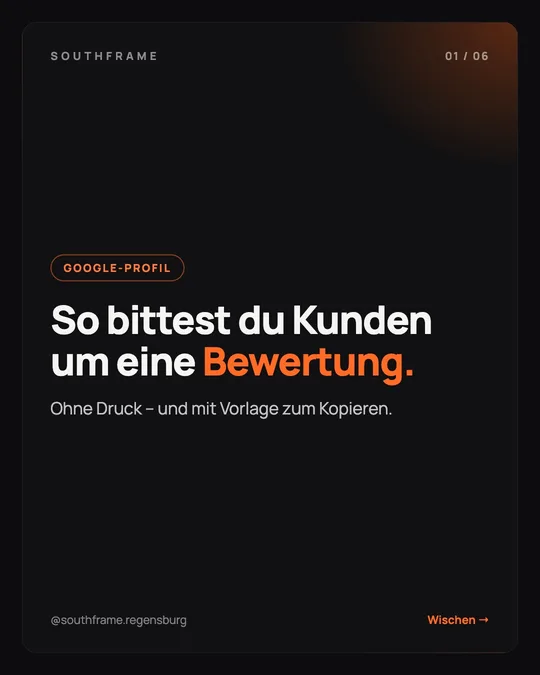
This is how Southframe’s Instagram posts are made: AI writes and designs, I just approve. I can build the same for your business, in your tone and your design.


Starting point
Data is moved manually between emails, spreadsheets and different systems.
Employees answer similar inquiries over and over or search for the same information.
Content has to be read, sorted, summarized or transferred manually.
Information lives in inboxes, files or the heads of individual employees.
Recurring tasks are done by hand every day, even though parts of them could be automated.
Packages
No big project on a hunch: first we check where AI really takes work off your plate, then we build a workflow and, if you like, keep it running.
Free
Is AI even worth it for you?
Project
From plan to a running process.
Optional
So it keeps running after launch.
You decide after every step whether to continue.
Request your free AI potential checkScope
And sometimes the most honest advice is: don’t automate. If effort, data quality or data protection aren’t worth the benefit, I’ll tell you straight.
AI potential check
I look at one or more of your recurring processes and give you a first assessment of where automation or AI could make sense.
The check focuses on the most important starting points and gives you initial direction for possible automations.
You briefly tell me which task currently costs the most time or coordination.
I look at which steps can be automated and where AI could sensibly help.
You receive a first recommendation on sensible next steps.
What I look at:
Which tasks come back regularly?
Where does unnecessary manual work arise?
Which information is needed and where does it live?
Which tools need to talk to each other?
Where can AI sensibly help?
Where must a person deliberately stay involved?
 12+ years of experience
About me
Southframe supports businesses in Regensburg, Germany, and the surrounding region with AI consulting, AI automation and digital processes – personally and in plain language. Projects well beyond the region are equally possible.
Good to know
AI consulting means working with a business to find out where artificial intelligence actually delivers value in everyday work: existing processes are mapped, time sinks identified, use cases weighed by effort and benefit, and suitable tools selected. The goal is not to introduce as much technology as possible, but to use AI where it noticeably takes work off your plate.
Well suited are processes that are clearly defined, recur regularly and work with information that can be structured: pre-sorting emails, structuring inquiries, summarizing documents, transferring data between systems, preparing reports or making internal information findable. Less suitable are processes that are vaguely defined or where every decision is an individual case.
No – quite the opposite: the starting point is your process, not a tool. Which solution fits – a language model, an automation platform or a simple rule with no AI at all – follows from the task, your existing software, data privacy and maintainability. Making exactly that choice is part of the consulting.
Classic process automation executes clearly defined, rule-based steps automatically: a trigger starts the workflow, data gets processed and passed on. AI extends this to tasks involving unstructured content – understanding emails, summarizing documents, drafting texts. In practice, good solutions combine both, and sometimes simple automation is entirely sufficient.
Often yes – small and medium-sized businesses in particular benefit, because a few people there fill many roles. AI pays off above all where recurring, rule-based tasks tie up a lot of time: many similar inquiries, manual data transfer, document processes or time-consuming information searches. Whether and where it pays off is revealed by an honest process analysis – not every task needs AI.
In most cases, yes. AI can complement existing systems via interfaces – for example email, forms, CRM, document storage or business software with an API. Replacing a system is only up for discussion when the existing software itself is the actual problem. I check technical feasibility early – and to be honest: not every system can be sensibly connected.
Wherever it matters: yes – and that is by design. Many workflows work best with human approval: the system prepares, sorts or drafts, and a person decides on the final step. I define these checkpoints deliberately – especially for customer communication, quotes or sensitive data.
From the start, not as an afterthought: I clarify which data flows into a process, where it is transferred and which providers are involved. Personal data is reduced to what is necessary, access rights and approvals are clearly defined, and sensitive steps remain with a human. I do not replace legal advice – where needed, I coordinate the implementation with your data protection officer or legal counsel.
That depends on the scope. Simple workflows – such as pre-sorting inquiries or structuring form data – can often be implemented within a few days to weeks. Integrations across multiple systems take longer. A credible estimate is only possible after mapping the process – blanket timelines without looking at your workflows would not be honest.
That depends on the process and the scope – a single automation is something different from a project spanning multiple systems. That is why I do not work with package prices: after the free AI potential check or an initial conversation, you receive a transparent, individually calculated quote.
You describe a process that currently costs a lot of time or coordination. I check which steps can be automated and where AI could sensibly help – and you receive a first assessment with sensible next steps. The check focuses on the most important starting points; it does not replace full process consulting, but it gives you clear initial direction.
No. My focus is on personal AI consulting in and around Regensburg – but I deliver automation and digitalization projects throughout Germany, and coordination also works entirely remotely.